




The insider field guide to who AI and ML engineers really are in 2026, what they actually cost, where they hide, and how to land them.
Meta reportedly offered one machine learning engineer a package worth up to $1.5 billion over six years, more than it paid for entire companies a decade earlier - Calcalist. That single number tells you the ground has shifted under everyone who hires technical talent. The people who build artificial intelligence have become the most expensive, most contested, and most misunderstood workers in the global economy, and the old recruiting playbook does almost nothing to help you find or win them.
The trouble is that "AI engineer" has quietly become one of the most slippery job titles in technology. The same two words now describe a 23-year-old shipping a chatbot on top of a public API and a tenured researcher who has personally trained a frontier model, and the gap between those two people is measured in millions of dollars and years of irreplaceable experience. Most hiring managers cannot tell them apart on a resume, most job descriptions ask for the wrong things, and most sourcing tools surface the loudest profiles rather than the strongest ones. Meanwhile the genuinely scarce talent, the few thousand people who can move a model's capabilities, almost never apply to anything.
This guide is the practical map of that market, written for someone who has to act on it rather than read headlines about it. It covers what an AI or ML engineer actually is in 2026 and the five distinct roles hiding under the label, how many of them exist and how badly they are wanted, what each tier really earns, where they physically live, the exact signals that separate builders from buzzwords, what makes them say yes, how to screen them without getting fooled, the recruiting ecosystem that has grown up around them, and how AI agents are now reshaping the hunt itself. It assumes no machine learning background, only that you need to win at this.
This guide is written by Yuma Heymans (@yumahey), founder of HeroHunt.ai and a former Bain and KPMG consultant who has been building AI sourcing technology since 2021. He spends his days on the exact problem at the center of this market, finding scarce specialists who are not on any job board, which is precisely why he writes about how the labs do it.
Contents
- What an "AI/ML Engineer" Actually Is in 2026
- The Numbers: How Many Exist and How Badly They Are Wanted
- What They Really Cost: The 2026 Pay Reality
- Where AI and ML Engineers Physically Live
- Where to Find Them and How to Read the Signal
- What They Actually Want (It Is Rarely Just Money)
- How to Screen Them Without Getting Fooled
- The Recruiting Ecosystem and the Players
- How AI Agents Are Changing the Hunt
- The Future and the Bubble Question
- The Recruiter's Playbook
1. What an "AI/ML Engineer" Actually Is in 2026
The single most useful thing to understand before you source a single candidate is that "AI engineer" is an umbrella stretched over at least five very different jobs that share almost nothing except a Python interpreter. Get the role wrong and everything downstream breaks: you write the wrong job description, screen for the wrong skills, benchmark against the wrong salaries, and lose the candidate you actually needed to a competitor who understood the distinction. The roles are not interchangeable, and the people who fill them are not substitutes for one another, so the first discipline is naming precisely which one you mean.
The clean taxonomy runs along two axes: how close the person sits to training the model, and whether they originate ideas or operate systems. A Research Scientist sits closest to the frontier, originates novel methods, and almost always holds a PhD with first-author papers at top venues - Chip Huyen. A Research Engineer turns those ideas into running experiments at scale and increasingly co-authors the papers, but does not need a doctorate. A Machine Learning Engineer owns the full model lifecycle in production: training, deployment, monitoring, and retraining. An ML Infrastructure or platform engineer builds the distributed-training and GPU systems everyone else depends on. And the newest archetype, the Applied AI Engineer, ships products on top of foundation-model APIs and may never train a model at all.
That last role is the one rewriting the whole market, and it has a clear origin. The title "AI Engineer" was crystallized by Shawn Wang, who writes as swyx, in a 2023 essay arguing that the world held roughly 5,000 LLM researchers but 50 million software engineers, so a new role would emerge for builders who use models rather than train them - Latent Space. His structural prediction has come true with force: LinkedIn named AI Engineer the fastest-growing job title for young workers two years running, adding 75,000 such US roles between 2023 and 2025 - CBS News. The practical consequence for you is that the same search term now returns two populations with a tenfold pay gap, and conflating them is the most common and most expensive sourcing mistake in the field.
These roles also differ in their daily texture, which is the fastest way to sanity-check whether a candidate fits the job you actually have. A research scientist spends real time reading papers, forming hypotheses, and arguing about methods, and is miserable in a role that is mostly shipping features. An ML engineer lives in training pipelines, data quality, and the unglamorous work of keeping a model healthy in production, and will be frustrated by a research role with no path to deployment. The applied AI engineer, by contrast, optimizes for speed of iteration on top of an API and often does not want to go near a training run. The median advertised pay for the applied AI engineer now sits around $138,000, far below the frontier research bands, which is precisely why the title confusion is so financially dangerous: a hiring manager who writes "AI engineer" while picturing a model trainer will benchmark, screen, and budget against the wrong half of the market - CBS News.
The diagram below maps the family tree. It is worth internalizing before you read a single resume, because the channel that is perfect for finding one branch is useless or misleading for another, a point the sourcing section returns to in detail.
What these people actually work on has also shifted, which matters because the skills on a strong 2026 resume look different from a strong 2023 one. The old recipe of pretraining a giant model and then applying human feedback is no longer the whole game. As one technical survey of the field bluntly puts it, that recipe is effectively dead, and every recent frontier model now leans on a different post-training stack built from supervised fine-tuning, preference optimization, and reinforcement learning with verifiable rewards - LLM-Stats. Techniques with acronyms like GRPO and RLVR sample many candidate answers per prompt and grade them automatically, which moves the bottleneck from collecting human labels toward designing the environments and reward signals models train against.
For a recruiter, the takeaway is to learn the new vocabulary of demand even if you never touch it yourself. The hottest skills in 2026 cluster around reinforcement learning, evals, and inference optimization, where tools like vLLM and OpenAI's Triton let engineers write GPU kernels in Python that rival hand-tuned code - vLLM Blog. On the applied side, the fastest-growing cluster is agentic work: Lightcast found mentions of agentic AI skills grew over 280% in a single year, from 0.06 percent of US postings to 0.23 percent - Lightcast. When a candidate can speak fluently about RL environments, eval harnesses, or multi-agent orchestration, they are signaling that they live where the work has actually moved, and that fluency is far more predictive than a list of frameworks.
On demographics, the population is smaller, more credentialed, and less diverse than the hype implies. The field skews heavily toward graduate degrees at the research end and toward self-taught builders at the applied end, and it remains stubbornly male: women make up only roughly a fifth to a quarter of the AI workforce and well under 15 percent at senior levels, a ratio that has barely moved in a decade - Stanford HAI. Understanding who is actually in the pool, and how thin it is at the top, is the foundation for everything that follows, because scarcity is the force that sets the price, dictates the geography, and explains why these candidates behave nothing like the engineers you hired five years ago.
2. The Numbers: How Many Exist and How Badly They Are Wanted
The defining fact of this market is a brutal inversion: demand for AI and ML engineers is exploding at the exact moment the broader tech job market is shrinking, and the supply of genuinely qualified people is growing far too slowly to close the gap. If you remember one structural truth before you start sourcing, make it this one, because it explains the salaries, the poaching, the ghosted outreach, and the leverage that sits entirely on the candidate's side of the table.
Start with demand, which has gone vertical. Job postings requiring AI skills grew 73 percent from 2023 to 2024 and then accelerated to 109 percent from 2024 to 2025, according to Lightcast's analysis of more than 1.3 billion postings - Lightcast. The divergence from everything else is the part that should reshape how you think. Indeed's Hiring Lab found that, at the end of 2025, postings mentioning AI sat 134 percent above their early-2020 baseline while total postings were only about 6 percent above it and actually falling year over year - Indeed Hiring Lab. AI is not a hot sub-segment of a hot market. It is a boom inside a contraction.
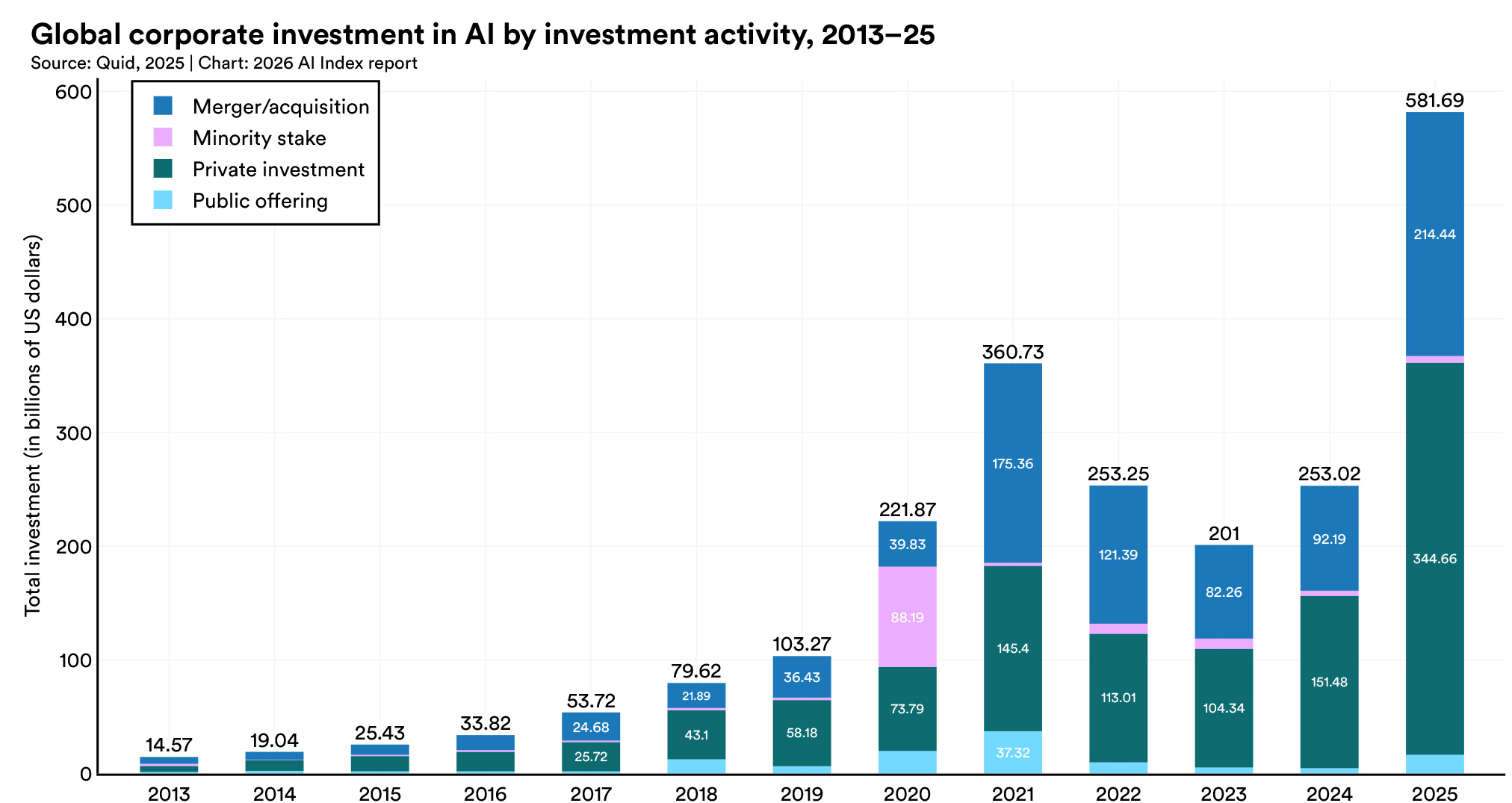
That boom is funded by an investment wave with no precedent. Global corporate investment in AI reached $581.69 billion in 2025, more than double the prior year, with US private investment alone running at 23 times China's - Stanford HAI. Every dollar of that capital eventually turns into a hiring requisition, which is why the demand curve keeps bending upward even as layoffs dominate the headlines. The chart below shows the shape of the money behind the talent war, and it is worth pausing on the jump in the final bar.
Now look at supply, which is where the math becomes painful. The pipeline that produces genuine experts is almost fixed in the short run. US universities graduate only about 3,000 AI-related PhDs a year, and AI-relevant doctoral output has grown under 3 percent annually against software-posting growth above 30 percent - CSET. Worse for industry recruiters, the small recent uptick in new AI PhDs has flowed back toward academia rather than into companies, with the industry share of new doctorates falling from a peak of 77 percent to roughly 63 percent - Stanford HAI. The faucet is barely open, and some of the water is now running the other way.
At the very top the scarcity becomes almost absurd. The entire global pool of elite, top-conference researchers numbers only in the low thousands: roughly 4,622 researchers published at NeurIPS in a recent year, and analysts estimate that the people who can actually lead a large-scale pretraining run number in the low hundreds worldwide - MacroPolo. This is the root cause of the nine-figure offers. When the population that can do a specific job fits in a single conference ballroom, normal salary logic stops applying, and a single hire can be worth more than an entire product line. The chart below makes the supply-demand scissor concrete.
AI Skills as a Share of US Job Postings
The demand is also worth real money to the candidate, which sets a floor under every negotiation you will run. Lightcast found that AI skills carry roughly a 28 percent salary premium, nearly $18,000 a year, across all postings that require them - Lightcast. PwC's measure of the same effect, weighted toward productivity in AI-exposed roles, runs even higher, reaching a premium above 50 percent in its 2026 reading. For a budget owner, the implication is that an "AI engineer" req is not a normal software req with a fashionable label; it is a structurally more expensive hire whose price is set by a market far larger than your own industry. Pretending otherwise is how requisitions sit open for six months while the hiring manager wonders why nobody good will talk to them.
The cruelest twist is the paradox that makes this market so hard to read from the outside: the same year brought record AI spending, roughly 157,000 tech layoffs, and a sharp entry-level squeeze, all at once - Fortune. It would be easy to conclude that engineering is dying. The data says the opposite for experienced builders. SignalFire's analysis found engineering was the most resilient tech function, with hiring down only 11 percent versus 2019 against a 25 percent drop for tech overall, and engineers making up 55 percent of new hires at the largest tech companies - TechCrunch. The squeeze is concentrated on juniors and on roles AI can absorb, not on the people who build the systems.
For your sourcing strategy, this paradox is not trivia, it is the operating environment. It means the market is bifurcated: a glut of generalist applicants competing for shrinking junior roles, and a desert at the experienced and specialist end where you actually need to hire. By one widely cited estimate there are roughly 3.4 open AI roles for every qualified candidate, and while that exact ratio comes from aggregators and should be held loosely, the direction is not in doubt - LinkedIn Economic Graph. Treat inbound applications as noise for senior roles, assume the people you want are employed and not looking, and build a process designed for proactive outreach rather than posting and praying. Every later section in this guide is downstream of that one reality.
3. What They Really Cost: The 2026 Pay Reality
Compensation for AI and ML engineers in 2026 splits into two almost non-overlapping universes, and the first job of any hiring leader is to know which one they are actually competing in. At the top sit the frontier labs, where total compensation routinely runs from $600,000 to well over $1 million for a single senior engineer. Everywhere else sits the rest of the economy, where a strong applied AI engineer earns $170,000 to $250,000 - Kore1. The gap is roughly three to five times, it is concentrated almost entirely in equity, and it is the reason so many enterprise searches stall: the company benchmarks against last year's software salaries and never realizes it is bidding in the wrong league.
The frontier numbers are public and specific, because levels.fyi captures self-reported packages in detail. At OpenAI, software engineer total compensation runs from about $254,000 at junior levels to a median near $805,000, with the L5 band sitting around $865,000 (roughly $322,000 base plus $543,000 in equity) and staff-level L6 clearing $1.2 million - levels.fyi. xAI's machine learning engineers show a median near $690,000, and Anthropic's software engineers a median around $674,000 with leads near $785,000 - levels.fyi. Meta, even as the aggressor in the talent war, posts a more modest machine-learning-engineer median around $476,000, which tells you the headline nine-figure offers are reserved for a handful of named researchers, not the median hire - levels.fyi.
To see the two universes side by side, the chart below puts frontier-lab medians next to a typical enterprise package. The point is not the precise dollar on any bar but the size of the cliff between them, because that cliff is what you are quietly negotiating against on every offer.
Median Total Compensation, AI/ML Engineer Roles (2026)
It is worth separating two questions that hiring managers constantly merge: how much a role pays, and how much a specific person can extract. The role bands above describe the former. The latter is set by leverage, and in this market the leverage sits almost entirely with the candidate, because the people you want are employed, not searching, and they know it. A useful and underappreciated fact is that roughly 71 percent of AI and ML positions are filled by engineers whose current title is not "AI" or "ML" at all, including infrastructure engineers who happen to run GPU clusters and strong backend engineers who learned the stack on the job - Pin. That matters for both budget and sourcing: the adjacent engineer who can grow into the role is often more available and more affordable than the person with the perfect title, and bidding only on titled specialists guarantees you compete in the most expensive, most contested slice of the market.
The research-versus-engineering split shows up in pay as well, and getting it wrong distorts a budget. A research scientist at a large lab is not automatically paid more than a strong engineer; at Google, research scientist total compensation runs to a median around $305,000, with senior bands near $481,000, which sits below the software-engineering medians at the frontier labs - levels.fyi. The premium in this field attaches less to the word "scientist" than to scarce, hard-to-fake capability: experience leading a large training run, demonstrated reinforcement-learning depth, or authorship of a model people actually use. When you price a role, price the capability you need rather than the prestige of the title, because the market rewards the former and quietly ignores the latter.
The very top of the market produced the numbers that broke through to the mainstream, and they are worth getting right because they are constantly misquoted. In mid-2025 Sam Altman claimed Meta had dangled $100 million signing bonuses to lure OpenAI staff, a figure Meta's own leadership called dishonest and which appears to describe total multi-year packages rather than literal cash-on-signing - Fortune. The most extreme reported figure, the $1.5 billion over six years said to be offered to a Thinking Machines co-founder, was stock-performance-contingent and disputed by Meta as inaccurate. The pattern is consistent: real numbers, breathless framing, and a gap between the headline and the wire transfer. For a recruiter, the discipline is to quote these as illustrations of top-of-market scarcity pricing, not as benchmarks any normal hire will see.
The video below, from a markets-focused show that covered the war as it unfolded, is a useful primer on why rational companies started paying these sums and what they were actually buying. It frames the bidding as a bet that a tiny handful of people will make the breakthroughs, which is exactly the scarcity logic the numbers section laid out.
Meta vs. OpenAI: Who Will Win the AI Talent War?
Two structural features of frontier pay matter even if you will never match it, because they shape what your candidates compare your offer against. The first is that equity now dominates, often 55 to 70 percent of a top package, which means the headline number is a bet on a private valuation rather than guaranteed cash - Pin. OpenAI historically paid in profit-participation units capped at a 10x return before shifting toward conventional equity in a 2025 restructuring - levels.fyi. The second is the rise of explicit retention machinery: after Meta poached more than 50 researchers, OpenAI's leadership described working around the clock to recalibrate compensation and counter offers, with one executive saying it felt like someone had broken into their home - TechCrunch.
For the 99 percent of employers who cannot pay frontier rates, the practical conclusion is liberating rather than depressing. You are almost never competing head-to-head with OpenAI for the same person, because the people who can command $800,000 are a tiny minority and are mostly already inside the labs. Your real competition is the rest of the normal market, where a well-constructed package of $180,000 to $280,000 plus genuine ownership and interesting work is fully competitive. The mistake is to either panic at the headline numbers and give up, or to ignore them and lowball against three-year-old benchmarks. Price the role to its real tier, be honest about which universe you are in, and spend your energy on the non-cash levers that the attraction section covers, because for most candidates below the frontier those levers decide the offer.
4. Where AI and ML Engineers Physically Live
AI and ML talent is geographically concentrated to a degree that should directly shape where you look and what you offer, because the supply is not spread evenly across a map. In the United States, more than 65 percent of AI engineers are clustered in just two metros, the San Francisco Bay Area and New York City - SignalFire. That concentration is self-reinforcing: the labs are there, the capital is there, the conferences and meetups are there, and proximity to other strong engineers is itself one of the things this population most values. If your strategy assumes you can hire frontier-adjacent talent cheaply in a secondary market, the geography is working against you before you send a single message.
Zoom out to the global picture and a second pattern dominates: the United States wins the talent war mostly by importing the winners, not by producing them. The MacroPolo tracker, built from top-conference authorship, found US institutions employ 59 percent of the world's elite AI researchers while training only about a quarter of them, and that 72 percent of China-educated elite researchers end up working in the US - MacroPolo. The American lead is real but borrowed, resting on a pipeline of foreign-born talent that flows toward US labs. For a recruiter, this means the best candidate for a US role was very often born and trained somewhere else, and immigration status is not a footnote but a central variable in whether you can actually hire them.
That borrowed lead is now under visible strain, which creates both risk and opportunity depending on where you sit. The number of AI researchers moving to the US fell 89 percent from its 2017 level, with an 80 percent drop in a single recent year, even as domestic demand kept climbing - Stanford HAI. The policy environment made it worse: a September 2025 proclamation imposed a $100,000 fee on new H-1B petitions, and while a federal court later struck it down as an unlawful tax, the chilling effect was immediate and uneven - Fortune. Tellingly, the labs leaned in while big tech pulled back, with OpenAI's certified H-1B filings more than tripling year over year while Amazon, Google, and Microsoft posted steep declines. The companies that treat visa sponsorship as a core capability rather than an afterthought are quietly winning candidates the giants are now hesitating on.
The rest of the world is not standing still, and the smartest recruiters are sourcing where the talent is growing rather than only where it has historically pooled. India posted the world's second-fastest growth in AI talent on LinkedIn between 2019 and 2025, China retains a rising share of its own elite as DeepSeek and domestic labs give researchers reasons to stay, and hubs like London, Paris, Zurich, Toronto, and Tel Aviv anchor serious frontier work outside the US. When you treat geography as a live strategy rather than a fixed constraint, the picture changes from scarcity to arbitrage.
The practical move that falls out of this map is to treat geography as arbitrage rather than as a fixed cost. The frontier labs concentrate in a handful of expensive metros and increasingly demand presence there, which leaves enormous, genuinely strong populations underbid in cities the giants are not fighting over. A senior engineer in Bengaluru, Warsaw, Lisbon, or Toronto can be every bit as capable as one in the Bay Area while commanding a fraction of the package and facing far less competing demand. The catch is that this only works if you build the operational muscle to support it: real remote infrastructure, time-zone-aware team design, and a willingness to sponsor visas or hire through an employer of record rather than treating either as a blocker. Companies that develop that muscle convert the scarcity at the center into abundance at the edges, while companies that insist on hiring within a 30-mile radius of a frontier lab pay the maximum price for the minimum pool.
Two further practical points round out the geography question. The first is that remote work, the great equalizer of the 2020-2022 era, has narrowed sharply at the frontier: most leading labs now expect meaningful in-office presence, with even mission-driven Anthropic setting a roughly 25 percent in-office expectation - SignalFire. The second is that this return to office is itself a recruiting lever you can use in reverse. If the frontier labs increasingly demand presence in two expensive metros, a genuinely flexible or remote-friendly role becomes a differentiator for the large population of strong engineers who will not, or cannot, relocate to the Bay Area. Geography constrains the giants too, and that constraint is your opening.
5. Where to Find Them and How to Read the Signal
The core skill of sourcing AI and ML engineers is reading proof-of-work signals that are mostly public, because the strongest people in this field leave a verifiable trail that ordinary candidates do not. A resume is a claim; a merged pull request to a major framework, a first-author paper at a top venue, or a widely used open-source model is evidence. As one sourcing analysis puts it, a GitHub repository is evidence while a PDF is a claim, and internalizing that hierarchy is what separates recruiters who find real engineers from those who collect keywords - Saral. The work of this section is learning which trails are real and which only look impressive.
Start with the highest-signal channel, which is contribution to the tools the field actually runs on. A merged pull request to a project like vLLM (around 84,000 GitHub stars) or Hugging Face's transformers library (around 162,000 stars) is hard to fake and harder to fluke, because the maintainers gate it - GitHub. Publication signal works the same way: an author with first-author papers at NeurIPS, ICML, ICLR, or CVPR has cleared a bar that cannot be bought. Those venues are also where the talent physically congregates, and their scale tells you how concentrated the field is. NeurIPS 2025 received a record 21,575 submissions and accepted just 24.5 percent, then sold out its venue at roughly 29,000 registrants - NeurIPS. A single accepted paper means a person sat near the top of a pool of tens of thousands.
Publications open a second, richer trail once you learn to read it. Google Scholar and arXiv let you see not just whether someone published but how their work landed: a high citation count or a strong h-index signals that other researchers built on what they did, and first authorship signals they drove the work rather than rode along on it. OpenReview, where venues like ICLR run public peer review, lets you read the actual critiques of a candidate's paper and how they responded, which is a rare window into how they think under scrutiny. Hugging Face adds a complementary signal for builders rather than authors: a developer who has published a widely downloaded model or dataset on a hub now hosting millions of them has shipped something real and measurable. Each of these channels rewards a different kind of talent, which is exactly why you triangulate across several rather than trusting any one.
A worked example shows how the signals combine in practice. Imagine two candidates who both list "LLM fine-tuning" and "PyTorch." The first has a forked repository with no original commits, a certificate from an online course, and a resume full of framework names. The second has three merged pull requests to a serving framework, a second-author paper at a workshop, and a small fine-tuned model on Hugging Face with real downloads. On a keyword match they look identical, and a naive search ranks the louder profile higher. On evidence, the second candidate has cleared bars that cannot be faked while the first has only collected nouns. The entire craft of sourcing in this field is learning to see that difference quickly, at scale, across hundreds of profiles, which is where both human expertise and good tooling earn their keep.
The harder skill is distinguishing a genuine machine learning engineer from a candidate who has decorated a resume with the right nouns. The field is full of soft signals that look like hard ones, and learning to tell them apart is most of the job.
- Hard signals worth chasing: merged PRs to core ML repos, first-author papers at top venues, authored models or datasets on Hugging Face, and a Kaggle Competitions Grandmaster badge.
- Soft signals to discount: a long list of framework names, certificates from online courses, "worked with LLMs" with no shipped artifact, and forked repositories with no original commits.
Those bullets compress a real judgment, so weigh them rather than counting them. Scarcity is the reason the hard signals matter: only about 600 people worldwide hold Kaggle Competitions Grandmaster status out of more than 23 million registered accounts, which is why that single badge carries so much weight - Kaggle. But scarcity also makes signals noisy at the edges. Competition data shows that more than half of winning solutions came from solo, first-time winners and cost under $100 in compute, which means raw Kaggle ranking rewards a specific kind of talent that may or may not translate to building production systems - ML Contests. Use signals as evidence to weigh, never as a checklist to tally.
The credential trap deserves its own warning because it costs companies the most. A candidate who has only ever called a foundation-model API is an Applied AI Engineer, which is a legitimate and valuable role, but it is a different job from training or fine-tuning models, and a resume that lists "GPT-4," "LangChain," and "RAG" tells you nothing about whether the person can debug a training run or reason about a model's internals. The frontier labs encode this distinction explicitly. Anthropic's research engineer postings state that formal credentials and a publication history are not required, valuing instead demonstrated skill with PyTorch, distributed systems, and reinforcement learning environments - Anthropic. The lesson is to source for evidence of the specific work you need, not for the brand names that happen to cluster around it.
The most aggressive sourcing tactic in 2026 is not finding individuals at all, it is buying whole teams, and you should at least understand it even if you cannot afford it. The reverse-acquihire became the signature deal of the era: Meta paid roughly $14.3 billion for 49 percent of Scale AI largely to bring in its founder, Microsoft absorbed most of Inflection, Amazon took Adept's team, and Google paid about $2.4 billion to license Windsurf and hire its leaders. These deals exist precisely because the scarcity at the top is so extreme that an entire functioning team is worth more than any sum of individual hires. For everyone operating below that altitude, the practical echo is to think in terms of intact teams and trusted clusters, because in this field people move in groups around leaders they believe in, a dynamic the next section unpacks.
6. What They Actually Want (It Is Rarely Just Money)
The most counterintuitive truth in recruiting AI and ML engineers is that the people commanding the highest salaries are the least motivated by salary, and the recruiter who only competes on cash will consistently lose the candidates who matter most. The evidence is hiding in plain sight in the retention data: Anthropic retains 80 percent of its two-year hires, ahead of DeepMind at 78 percent, OpenAI at 67 percent, and Meta at 64 percent, despite Meta and OpenAI paying more at the median - SignalFire. Engineers are roughly eight times more likely to leave OpenAI for Anthropic than the reverse. When the highest-paying option loses talent to a lower-paying one, money is clearly not the variable doing the work.
The single most powerful non-cash lever in 2026 is compute access, and it is the one most companies do not even think to offer. For a researcher, the ability to run frontier-scale experiments is the difference between doing meaningful work and being stuck, and the labs market it openly. When Mark Zuckerberg recruited for Meta's Superintelligence Labs, his explicit pitch was that the team would have industry-leading compute and by far the greatest compute per researcher, backed by gigawatt-scale data centers - TechCrunch. This works because compute is the binding constraint on the work itself; industry now produces more than 90 percent of notable frontier models precisely because that is where the GPUs are - Stanford HAI. If you cannot offer frontier compute, be honest about it and compete on the levers you can control.
After compute, the levers that move this population are mission, autonomy, and the caliber of colleagues, and the departures that made headlines prove it by showing what their absence costs. Yann LeCun, one of the most decorated researchers alive, left Meta in late 2025 rather than report into a reorganized structure, reportedly saying you certainly do not tell a researcher like him what to do - CNBC. When two star Google researchers departed within 24 hours in mid-2026, Alphabet's stock fell more than 5 percent, a market verdict on how much individual researchers and the conditions that keep them are worth - Fortune. The recurring theme in these exits is not pay but bureaucracy, mission drift, and loss of research freedom.
The flip side of attraction is retention under fire, and 2026 made clear that even the best-funded teams cannot simply buy their way out of a defection. When two of Google DeepMind's most prominent figures left within a day of each other for OpenAI and Anthropic, the moves were widely read as evidence that pay and prestige could not offset a culture researchers experienced as bureaucratic and slow - Fortune. The practical lesson for a hiring leader is that the counteroffer is the weakest tool you own. By the time a star is holding a competing offer, the things that would have kept them, real autonomy, the right colleagues, a mission they believe in, are usually already decided, and a last-minute pay bump rarely reverses a decision that was about something else. Retention is built in the eighteen months before the offer arrives, not in the panicked week after.
People in this field also move in groups, which is both a risk and an opportunity you can engineer. When Mira Murati left OpenAI to start Thinking Machines Lab, roughly 30 researchers followed her, and the company raised $2 billion before shipping a product - Wikipedia. The lesson for a hiring leader is that landing one respected leader can unlock an entire network, and losing one can drain a team. Sourcing the individual is often less effective than sourcing the gravitational center they orbit, which is why the strongest recruiters map relationships, not just resumes.
There is also a hard-nosed financial lever that has nothing to do with base salary: liquidity. As both Anthropic and OpenAI moved toward public offerings in 2026, the prospect of converting paper equity into real, generational wealth became a powerful pull and a retention pressure all at once - NBC News. A credible path to liquidity can outweigh a higher nominal package elsewhere, and a startup that can articulate that path competes above its cash weight.
Finally, do not underestimate the recruiting power of open-source reputation and a real mission. Hugging Face deliberately optimizes its employer brand around being the open-source backbone of the ecosystem rather than paying top-of-market base salaries, and it attracts engineers who value impact and visibility over raw cash - JobsByCulture. The practical playbook for any non-frontier employer follows directly: let your engineers publish and contribute to open source, give them genuine ownership and autonomy, be specific and sincere about your mission, and surround them with strong colleagues. Those levers are available to almost any company, they cost far less than a bidding war, and against most candidates below the frontier they are decisive.
7. How to Screen Them Without Getting Fooled
Screening AI and ML engineers in 2026 is harder than screening any other technical role, for two reasons that compound each other: the traditional signals have broken, and a thriving industry now exists to help candidates fake the rest. A hiring leader who runs a standard software interview loop will both reject strong builders and pass fraudulent ones, so the screening process needs a deliberate redesign around what actually predicts performance in this specific field. Getting this wrong is expensive in a way that is invisible until a bad hire fails to ship.
The first broken assumption is that abstract coding puzzles measure ML ability. They do not. A strong machine learning engineer is better assessed by ML system design (how would you build a feature store, a distributed training pipeline, or a model-serving stack), by from-scratch implementation of core components like a transformer block, LoRA, or a KV cache, and by a deep technical conversation about their own past work - Yuan Meng. The labs have converged on variations of this. OpenAI runs long onsite loops, Anthropic pairs a coding screen with an LLM-inference design discussion, and DeepMind gates candidates with a fundamentals quiz before its sub-1-percent acceptance funnel - Sundeep Teki. The common thread is testing judgment about real systems, not recall of algorithms a model can now write instantly.
The second and more disruptive problem is that AI-assisted cheating has gone from fringe to mainstream, and it hits technical interviews hardest. One detection vendor analyzing nearly 20,000 interviews flagged 38.5 percent of candidates for likely AI assistance, with technical interviews flagged at roughly four times the rate of sales roles - Fabric. The category even produced a venture-backed star: Cluely, founded by a Columbia student who built an interview-cheating tool and was suspended for it, raised $15 million from a16z - TechCrunch. When a meaningful share of your remote technical candidates may be reading model output in real time, an unmonitored video coding round measures the candidate's tooling, not their ability.
The industry's response has been swift and tells you what to copy. The defenses cluster into a handful of moves, each with real trade-offs in cost and candidate experience.
- Reintroduce in-person rounds for final technical assessment, the path Google publicly signaled it would take.
- Allow AI explicitly in a controlled round, then test how well the candidate directs and corrects it.
- Go deep on the candidate's real work, where fabrication collapses under follow-up questions.
Each of these has a cost, so choose deliberately rather than adopting all of them. In-person rounds are the most reliable defense but the most expensive and the most likely to lose remote candidates; one tech leader reported that 80 percent of candidates used a model on a take-home despite being told not to, which is why unsupervised assignments are losing favor - Karat. The most robust and lowest-friction defense is usually the deep-dive interview: ask a candidate to walk through a system they built, then probe the decisions, the failures, and the trade-offs. Real builders get more interesting under pressure, while fabricators run out of substance within two or three follow-ups.
It helps to understand why the deep dive is so hard to game, because the mechanism is what makes it your best defense. A fabricated or AI-assisted candidate can produce a plausible answer to a known question, but they cannot reconstruct the specific reasoning behind a system they never actually built. When you ask why they chose one architecture over another, what broke in production, how they diagnosed a training run that would not converge, or what they would change with hindsight, the genuine builder gets richer and more specific while the pretender gets vaguer and more generic. The labs lean on exactly this: a research job talk, where a candidate presents their own work and defends it against expert questioning for an hour, is nearly impossible to fake and is standard at the frontier. You do not need a lab's resources to copy the principle, only the discipline to keep asking "why" until you hit either bedrock or air.
Whatever rounds you choose, make the evaluation consistent, because the most common failure in ML hiring is not a weak interview but an unscored one. Different interviewers probing different things to different depths produce noise that the loudest opinion in the debrief then resolves, which is how strong quiet candidates get cut and confident weak ones advance. A simple calibrated scorecard fixes most of this: agree in advance on the few dimensions that matter for the specific role (system design, implementation depth, research judgment, communication), have each interviewer score only what they actually probed, and require evidence rather than impressions in the debrief. This is not bureaucracy for its own sake; it is the difference between a process that measures the candidate and one that measures whoever interviewed them. For a role this expensive and this hard to fill, a consistent screen pays for itself the first time it saves you from a confident bad hire.
Beyond cheating sits outright fraud, and AI roles are a prime target because they are remote, lucrative, and numerous. Gartner projects that by 2028 as many as one in four candidate profiles globally could be fake, and a Greenhouse survey found 31 percent of hiring managers had already interviewed a suspected deepfake candidate - HR Dive. The most serious documented case involved a scheme that placed North Korean IT workers into hundreds of US companies using stolen identities, with one facilitator sentenced after the operation touched 309 firms - US Department of Justice. The practical safeguards are unglamorous but effective: verify identity rigorously, confirm that public artifacts like GitHub and Scholar profiles actually belong to the person in front of you, and treat a polished resume with no verifiable public footprint as a question to answer rather than a reason to advance.
8. The Recruiting Ecosystem and the Players
A whole industry has grown up to broker AI and ML talent, and knowing its layers saves you from paying the wrong intermediary for the wrong job. The ecosystem now divides into roughly five categories, each solving a different problem at a different price: talent agents who represent individual stars, marketplaces that match specialists to projects, AI-powered sourcing platforms that help your own team find people, executive search firms that run retained leadership hunts, and the in-house recruiting machines the labs have built to defend themselves. Buying the right layer for your situation is itself a skill, because the fee structures and outcomes differ enormously.
The most striking new category treats top researchers like professional athletes. Startups now act as talent agents, representing engineers and negotiating their packages for a cut. Dex, a London startup that raised a $5.3 million seed in 2026, signed up more than 15,000 engineers and charges employers 20 to 30 percent of a hire's salary, the same as traditional search - Fortune. The investor Sarah Guo captured the shift by noting that there are now people helping researchers negotiate comp and taking a fee, like agents for athletes - Upstarts Media. For elite, passive candidates who would never respond to a cold message, going through their representation is increasingly the only door.
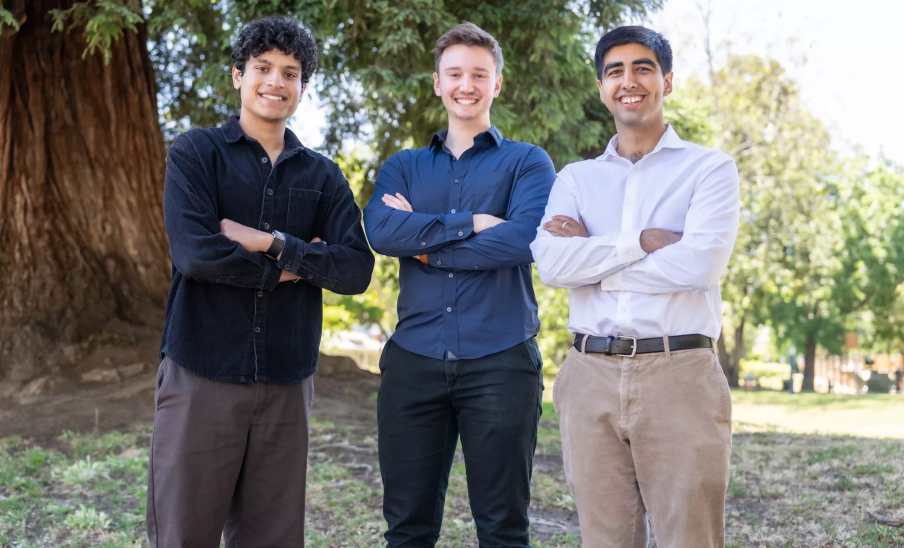
The second layer, talent marketplaces, has scaled to extraordinary size by matching specialists to the labs that need them. The breakout example is Mercor, which connects AI labs with domain experts and reached a $10 billion valuation on a $350M round in late 2025, paying out more than $1.5 million a day to a pool of over 30,000 experts - TechCrunch. Its three founders, all 22, became among the youngest self-made billionaires in the world on the strength of this single shift in how AI talent gets sourced - Wikipedia. The image below shows them, and they are worth remembering as the human face of how quickly this market minted fortunes.
A different marketplace model bets on humans over pure automation, and it is growing fast. Paraform pairs more than 10,000 specialized expert recruiters with AI tooling, has paid out $50 million to those recruiters, and saw top performers clear $300,000 in a single month - Paraform. Alongside it sit vetted elite networks like A.Team, which admits fewer than 2 percent of applicants and embeds senior builders into engagements. The takeaway across this layer is that if you need specialized AI skills on a project basis, or want access to pre-vetted experts without running a full search, these marketplaces have become a serious alternative to traditional hiring.
The third layer is the AI-powered sourcing platform, the software your own recruiters use to find candidates rather than a service that finds them for you. Tools such as SeekOut, hireEZ, Gem, Findem, and Juicebox each pull candidate data from many sources and increasingly layer AI search and outreach on top - Recruiting Tools Review. A newer wave of autonomous AI Recruiter platforms, such as HeroHunt.ai, pushes further by searching across more than a billion profiles and drafting outreach automatically, which suits teams that want to run proactive sourcing at scale without a large recruiting org. The right tool depends on whether your bottleneck is finding candidates, contacting them, or both, so diagnose the bottleneck before buying the subscription.
The fourth and fifth layers serve the top and the inside of the market. For leadership and the rarest specialists, retained executive search still dominates, with boutiques like Christian and Timbers and Harnham alongside the large firms, charging 25 to 33 percent of first-year compensation for a confidential, mapped search - Valuable Recruitment. The economics explain why this model survives at the top: on a $500,000 package, even a contingency fee runs into six figures, so for senior AI roles the exclusivity and depth of a retained engagement usually justify the cost. Meanwhile the labs themselves have built the fifth layer, formidable in-house engines that both source aggressively and defend their own. OpenAI famously runs a six-month residency that pays roughly $210,000 annualized to convert physicists and neuroscientists into AI researchers, on the theory, as Sam Altman put it, that missionaries beat mercenaries - Fortune. The lesson for everyone else is that the strongest competitor for your candidate may not be another offer but a company that has turned talent development and retention into a core capability.
9. How AI Agents Are Changing the Hunt
There is a deep irony at the center of this guide: the AI and ML engineers you are trying to recruit are increasingly being recruited by AI, and the same automation they build is reshaping both how they get hired and what you should hire them for. Recruiting itself has become one of the most aggressively automated functions in business, with roughly 69 percent of companies now using AI somewhere in talent acquisition and recruiters among the heaviest users of any role - Pin. Understanding this shift is no longer optional, because your competitors are already sourcing the same scarce candidates with tools that never sleep.
The flagship example is LinkedIn's Hiring Assistant, the platform's first true AI agent for recruiters, which became globally available in late 2025 and autonomously handles intake, sourcing, and outreach drafting - LinkedIn. Its traction is real money, not a pilot: LinkedIn's agentic talent products surpassed a $450 million annualized run-rate within months, a figure disclosed on Microsoft's earnings call. Specialized agents go further. Juicebox's autonomous agents continuously source across GitHub, Stack Overflow, and Google Scholar, which is exactly where AI engineers leave their proof-of-work, and draft tailored outreach with minimal human oversight - SiliconANGLE. The signal-reading discipline from the sourcing section is now partly executable by software, which raises the bar on what human recruiters must add.
This automation does not make human recruiters obsolete, but it does change what they are for, and the recruiters who thrive are the ones who move up the value chain rather than competing with the software on volume. When an agent can scan GitHub and Scholar faster than any person, the human edge shifts to the parts machines are bad at: judging whether a non-obvious candidate is actually a fit, writing the one message that makes a skeptical engineer curious, and building the genuine relationship that turns a "not looking" into a conversation. The scarcest engineers receive a flood of automated outreach and have learned to ignore all of it, which means a thoughtful, specific, clearly human approach now stands out more than it did when such messages were the norm. Automation raises the floor on sourcing volume and simultaneously raises the premium on human judgment at the top of the funnel.
It is worth holding a skeptical line here, because adoption is not the same as results. Gartner predicts that more than 40 percent of agentic AI projects will be canceled by 2027, and recruiting automation is not exempt from that failure rate - Gartner. Autonomous outreach that floods scarce engineers with generic messages can actively damage your employer brand with exactly the audience least tolerant of spam. The teams winning with these tools use them to widen the top of the funnel and to surface non-obvious candidates, while keeping a human on the high-stakes, relationship-driven moments where this population decides whether to engage at all.
The second-order effect is more profound than faster sourcing: AI coding tools are changing what an AI or ML engineer even is, and therefore what you should be screening for. Adoption among developers is now near-universal, with 84 percent using or planning to use AI tools and Cursor reaching a $2 billion revenue run-rate by early 2026 - Stack Overflow. At the leading edge the shift is total: engineers at Anthropic and OpenAI report that essentially 100 percent of their code is now AI-written, with one Anthropic lead saying he had not hand-written code in months while shipping dozens of pull requests a day - Fortune. The job is migrating from typing code to orchestrating agents, reviewing their output, designing evals, and reasoning about systems.
For a hiring leader, this reframes the entire specification of the role. Raw coding speed, the thing leetcode measured, is becoming a commodity that any competent engineer can rent from a model, while the durable, hard-to-automate skills are judgment, system design, debugging the non-obvious, and the taste to know when an agent's output is subtly wrong. The demand data already reflects this migration: the forward-deployed engineer, a builder who sits with customers and wires AI into real workflows, became one of 2026's hottest roles with postings up sharply and pay reaching into the high six figures - JobsByCulture. The recruiter who keeps hiring against a 2022 job description will keep losing to the one who understands that the work, and therefore the screen, has moved.
10. The Future and the Bubble Question
The honest answer to where this market is heading requires holding two ideas at once: the demand for people who can build and direct AI is real and durable, and the prices being paid for them in 2026 are probably not all sustainable. A recruiter who ignores either half will make bad bets, either dismissing the boom as hype and missing the talent, or chasing frontier comp into a war they cannot win. The pyramid view is that frontier judgment stays scarce while routine implementation gets automated, and your strategy should be built on that split rather than on this year's headlines.
The "will AI replace AI engineers" question is where the loudest predictions have already aged badly, which should make you cautious about the next round of them. In early 2025, Anthropic's CEO predicted AI would write 90 percent of code within months - Yahoo Finance. By mid-2026, with their labs eyeing trillion-dollar valuations, both he and Sam Altman were notably walking back the jobs-apocalypse framing, with Altman saying he was delighted to be wrong that feared entry-level losses had not materialized - Fortune. The reframing toward AI as a multiplier rather than a replacement matters for hiring: it suggests the people who direct these tools become more valuable, not less, which is the opposite of the automation-doom narrative.
The bubble skeptics deserve a real hearing, because their data is sobering and directly relevant to how aggressively you should be bidding. An MIT-affiliated study found that roughly 95 percent of enterprise generative-AI pilots showed no measurable profit-and-loss impact, despite tens of billions in spending - Fortune. If most corporate AI initiatives are not yet paying off, some of the demand and some of the comp inflation rests on expectation rather than realized return, and expectation can reprice quickly. The methodology has been contested, but the prudent reading is that the very top of the comp market is more fragile than the durable, broad-based demand for competent builders underneath it.
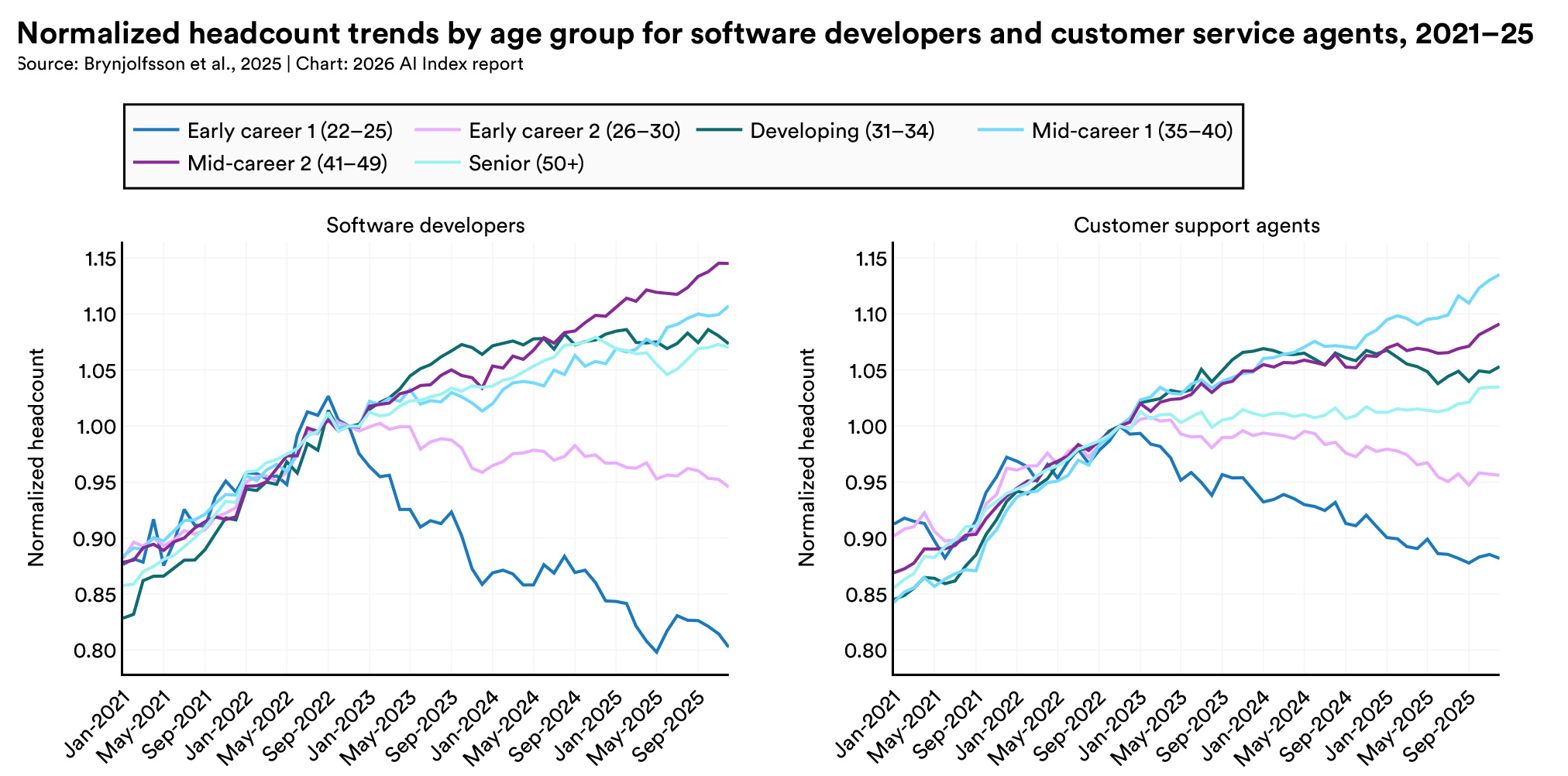
The clearest near-term trend is the entry-level squeeze, and it has uncomfortable implications for how the pipeline refills. As AI absorbs the routine coding that juniors once cut their teeth on, early-career hiring has contracted sharply, a pattern visible in the chart below where the youngest cohort of software developers diverges downward while everyone older keeps rising. The risk is structural: if companies stop hiring and training juniors, the senior talent shortage that drives today's bidding wars only deepens in a few years.
Two further shifts will shape the next two years and are worth building into your workforce plan now. The first is the rise of small elite teams: with AI multiplying individual output, a five-person pod can do what eight to ten people did in 2020, and Altman has floated the prospect of a one-person billion-dollar company - JoinNextDev. That favors hiring fewer, more senior, more autonomous people over building large junior teams. The second is where demand is migrating: away from generic model-building and toward reinforcement learning, evals, agent orchestration, and inference, the parts of the stack that are hardest to automate and least saturated with talent. If you are planning roles for 2027, weight them toward those frontiers.
Net it out and the strategic picture is clear enough to act on. The broad demand for engineers who can build with and direct AI is durable and will outlast any correction, so investing in this capability is not a fad. But the specific prices at the frontier carry real bubble risk, so anchoring your whole strategy to matching nine-figure offers is a trap. The winning posture is to hire durable judgment rather than perishable syntax skills, to keep developing junior talent even when AI makes it tempting not to, and to position your roles at the frontiers of demand rather than its crowded center. That posture wins whether the bubble deflates gently or not at all.
11. The Recruiter's Playbook
If you internalize nothing else, internalize the decision framework that falls out of everything above, because it converts a confusing market into a small number of choices you can actually make. The first and most important is to name the role precisely before you do anything else. Decide whether you need a research scientist, a research engineer, a machine learning engineer, an infrastructure engineer, or an applied AI engineer, because that single decision determines your salary band, your sourcing channels, your screen, and your realistic candidate pool. Almost every failed AI search traces back to a job description that blurred two of those roles together and therefore attracted and tested for the wrong person.
The second move is to know which pay universe you are in and price honestly within it. If you are not a frontier lab, you are almost never competing head-to-head with OpenAI, so stop benchmarking against $800,000 packages and stop apologizing for not matching them. Build a genuinely competitive offer for your tier, somewhere in the range of $180,000 to $280,000 for strong applied talent, and then win on the levers that actually move this population. Compute access where you can offer it, real autonomy, the freedom to publish and contribute to open source, a sincere mission, strong colleagues, and a credible path to liquidity beat raw cash for most candidates below the frontier, and they cost far less than a bidding war.
The third move is to source on evidence and screen on judgment. Find people through their proof-of-work, the merged pull requests, the first-author papers, the authored models, the conference acceptances, rather than through resume keywords that anyone can list, and treat senior inbound applications as the exception rather than the plan. Then screen with deep dives into real systems the candidate has built, design questions about realistic infrastructure, and at least one defense against AI-assisted cheating, because the old coding-puzzle loop now rejects strong builders and passes fabricators in roughly equal measure. Verify identity and public artifacts as a matter of routine, since fraud has become an industrialized threat rather than a rare one.
The fourth move is to use the ecosystem deliberately rather than defaulting to whatever is familiar. Match the layer to the need: talent agents and retained search for the rarest passive stars, marketplaces for specialized or project-based work, AI sourcing platforms and autonomous AI Recruiter tools when you need to run proactive outreach at scale, and your own employer brand and referral network as the compounding asset underneath all of it. Whichever tools you choose, keep a human on the moments that decide whether a scarce engineer engages, because this is the audience least forgiving of automation that feels like spam.
The last move is the strategic one: build for the durable trend, not the bubble. Hire judgment over syntax, keep developing junior talent even when AI makes skipping it tempting, position your roles at the frontiers of demand where the work is hardest to automate, and treat compute, mission, and culture as the recruiting assets they have become. The people who build AI are the scarcest, most contested talent in the world right now, and the recruiters who win them are not the ones with the biggest budgets, they are the ones who understand exactly who these people are and what they actually want. That understanding is the whole edge, and it is available to anyone willing to learn the market rather than just throw money at it.
This guide reflects the AI and ML talent market as of June 2026. Compensation, platforms, and policy in this field change month to month, so verify current details before making decisions based on them.